
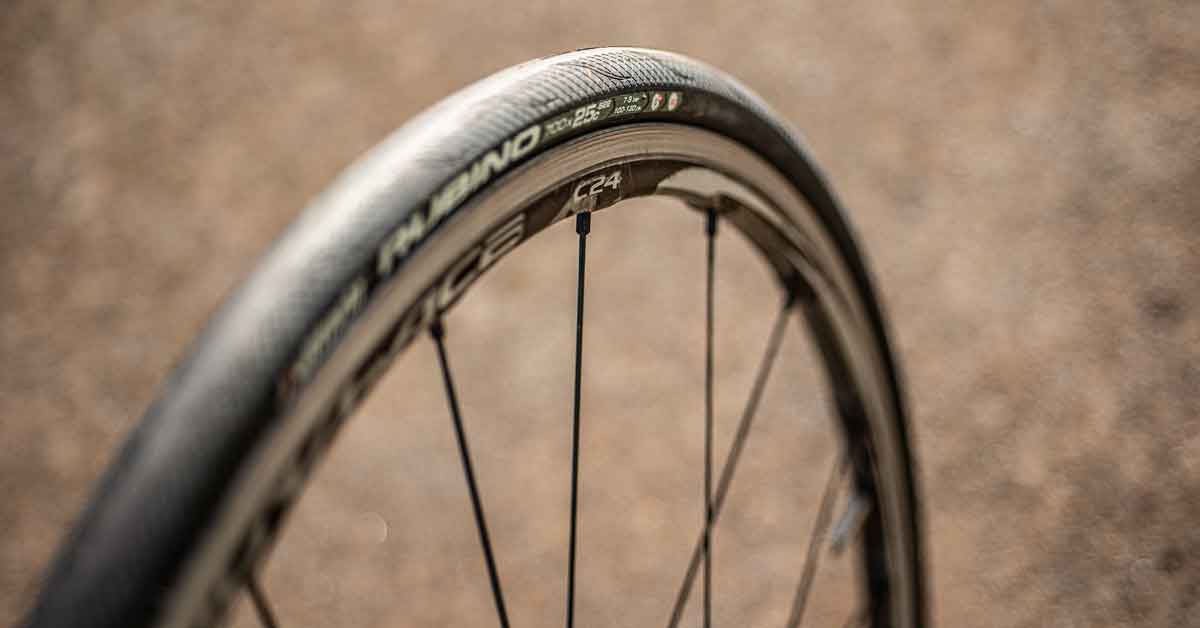
Bicycle tyre pressure is an important part of bicycle maintenance, handling and safety. This article discusses some basic guidelines for tyre inflation.
Ever had a massive blowout with your bicycle tyre? One minute you’re cruising down the road and the next minute an almighty bang goes off and your tyre deflates in milliseconds. Culprit? Over inflation. Really bad news if you are descending a hill at 70km/h, especially if it’s your front wheel.
What to do if you have a massive blowout in a bunch.
BTW. If this does happen to you when you are out riding in a fast and large moving bunch of cyclists, then raise your arm up and keep riding straight ahead while you are coasting to a standstill. If you do this, the other riders in the bunch can see where you are. This helps in two ways. Firstly; it shows them where the large bang came from and that it was only a puncture and secondly; it helps them to move around you safely as you are slowing down. As the bunch is going past you, try to keep it steady and keep your momentum going until they pass. Then when it’s safe to do so, move over to the side of the road and stop.
Higher inflation does not necessarily mean less rolling resistance.
Many people think this because on a smooth surface, hard tyres have a smaller contact area on the road, and that equals lower roll resistance. On a wooden velodrome, we do see very high tyre pressures because high tyre pressures do equal less rolling resistance on such smooth surfaces. But this doesn’t translate well out on the road. On the road, high tyre pressures slow you down and can be very unsafe when cornering. This is because roads are far rougher than your silky smooth and super-fast wooden velodrome. Proper tyre inflation helps your tyre roll over bumps and absorbs shock. Overinflate them, and they transmit harsh impacts through the bike, which reduces speed and your riding comfort.
On freshly laid bitumen, your tyres might feel great at 100 psi, but on a rough road like those found on rural roads, there is a good chance they’ll roll faster at 90 psi. In wet conditions, it becomes even more important to run your tyres at lower pressures to ensure you get good traction. When it’s wet, lower pressures also reduce the chance of sliding out of a corner and falling off. I recommend running your tyres at ten psi less than you would normally do in dry conditions.
If you’re a mountain biker who rides on single-track trails, you might find that your bike will feel better at 38 psi than the 50 psi that you run on the road.
So, just because your tyre may say that it’s rated up to 180 psi on the sidewall doesn’t necessarily mean that you should pump them up that hard!
Pumping your tyre up to the proper pressure lets your bike roll quickly, ride smoothly, and fend off flats.
Also, understand that narrow tyres need more air pressure than wide ones.
- Road tyres usually require 80 to 130 psi
- 26″ Mountain bike tyres usually 30 to 50 psi
- 27.5″ Mountain bike tyres usually 20-25 psi
- 29″ Mountain bike tyres usually 18-20 psi
- Hybrid tyres around 50 to 70 psi.
Tyre Pressure Guidelines.
For a 700 x 23c tyre on the road, a 55 kg rider should start with 100 psi while a 90 kg rider should run closer to 120 psi. For 700 x 25c tyres, minus 10-20 psi. Remember, never go above or below the manufacturer’s recommended pressures.
I run my Continental Gatorskins 700 x 25c tyres at 80 psi and my Vittoria Corsa Cx 700 x 23c at 100 psi. I weigh 68kg and ride mainly on rough country roads.
Start around the middle of these ranges then take into account your body weight to find your ideal tyre pressure. The more you weigh, the higher the tyre pressure needs to be.
Some tyres come with manufacture inflation recommendations. If they do then, please have a read of them and adjust your tyre’s inflation accordingly.
While installing some tubular tyres on my wheels recently, I took notice of their inflation instructions, and I believe that they provide some great insight into correct bicycle tyre inflation pressures.
Here are their guidelines (recommended for 700 x 23 mm tubular tyres).
Recommended bicycle tyre pressure by rider weight:
|
Tyre Pressure in psi (bar) |
||
| Rider weight in lbs (kg) |
Front |
Rear |
| Less than 125 (57) |
108 (7.45) |
112 (7.72) |
| 125-150 (57-68) |
114 (7.86) |
118 (8.13) |
| 150-175 (68-79.5) |
121 (8.34) |
126 (8.68) |
| 175-200 (79.5-91) |
130 (8.96) |
135 (9.31) |
| Greater than 200 (91) |
140 (9.72) |
145 (10.0) |
And now the really important stuff
Recommended bicycle tyre pressure adjustments by rider context:
|
Pressure or Pressure Adjustment |
||
| Riding Context |
Front |
Rear |
| Triathlon/TT |
Use rear pressure |
Same as above |
| Rain or Rough Roads |
Subtract 3-5 psi |
Subtract 4-7 psi |
| Indoor Track |
145 (10.0) |
145 (10.0) |
| Outdoor Track |
Add 5-7 psi* |
Add 6-10 psi* |
* The above tyre inflation pressures are recommended for optimal rolling resistance and grip. These pressures are for room temperature tyres and rims. Tyre pressures may increase as much as 25 psi due to high rim temperatures caused by prolonged braking or as much as 5 psi from high ambient or road surface temperatures.
Remember to not overinflate!
I have come across a few people that have quoted figures of 145 psi as their normal riding pressure for clincher training-type bicycle tyres. This I consider unnecessary and unsafe.
One important thing to remember is that some clincher rims have a maximum inflation figure of around 125 psi! So regardless of your rated inner tube and tyre combination, inflating your tyre above 125 psi on these rims could compromise the integrity and cause a rim failure and blowout too.
Check tyre pressure regularly
Tyres deflate overtime. It’s a quick process to get your trusty track pump out and top up your tyres. If you want to keep your rolling resistance at an optimum, then I recommend that you check your tyre pressure before every ride. But if you are less concerned about performance, then once a week is fine too. It’s up to your personal preference. If you are riding on rough roads or gravel roads, then keeping your tyres inflated so that their optimal pressure becomes more important to help avoid pinch flats.
Inner tubes that use butyl, deflate far less over time than the less common but lighter latex inner tubes. If you are using latex inner tubes, then you’ll need to stay on top of your tyre pressure more frequently than the more robust butyl inner tubes.
Also, remember that CO2 quickly permeates through butyl inner tubes, so it’s important to check your tyre pressure the morning after repairing a flat if you have used a CO2 canister to inflate your tyre. CO2 leaches out so quick that you’ll see a noticeable drop off in tyre pressure in only a few hours. If you are on a longer ride and have a puncture early you might also want to check your tyre pressure a few hours into the ride to make sure that it’s still ok.
Other articles of interest:
Slow Down To Speed Up Your Hill Climbing – Cycle Up Hills Fast
Difference Between Training with Heart Rate and Power
How To Work Out Your Cycling Heart Rate Zones
What Does Your Resting Heart Rate Mean?
Leave A Comment